What You’ll Learn
- What is Endometriosis?
- Endometriosis vs Adenomyosis vs Endometrial Polyps
- Common Causes of Endometriosis
- Symptoms to Watch For
- Natural and Homeopathic Medicine for Endometriosis in Pakistan
- Best Homeopathic Remedies for Endometriosis
- Diet and Lifestyle Tips
- When to See a Doctor
- Frequently Asked Questions
- Conclusion
- Note from the Clinic
Introduction
Here is something most women are never told: on average, it takes seven to ten years, and several visits to different doctors, for endometriosis to be correctly diagnosed. For years, the pain is often dismissed as “just bad periods,” something to grit your teeth through every month rather than a condition with a name and a cause.
If that sounds familiar, you are far from alone. Endometriosis is thought to affect roughly one in ten women of reproductive age, yet it remains one of the most underdiagnosed and misunderstood conditions in women’s health.
The good news is that once the cause is understood, there is a gentle way to support your body through it. Natural and homeopathic treatment for endometriosis works by addressing the whole picture, hormonal balance, inflammation, and pain patterns, rather than simply masking the discomfort. In this guide we explain what endometriosis is, why it happens, and how homeopathy can offer real support alongside proper medical care.
What is Endometriosis?
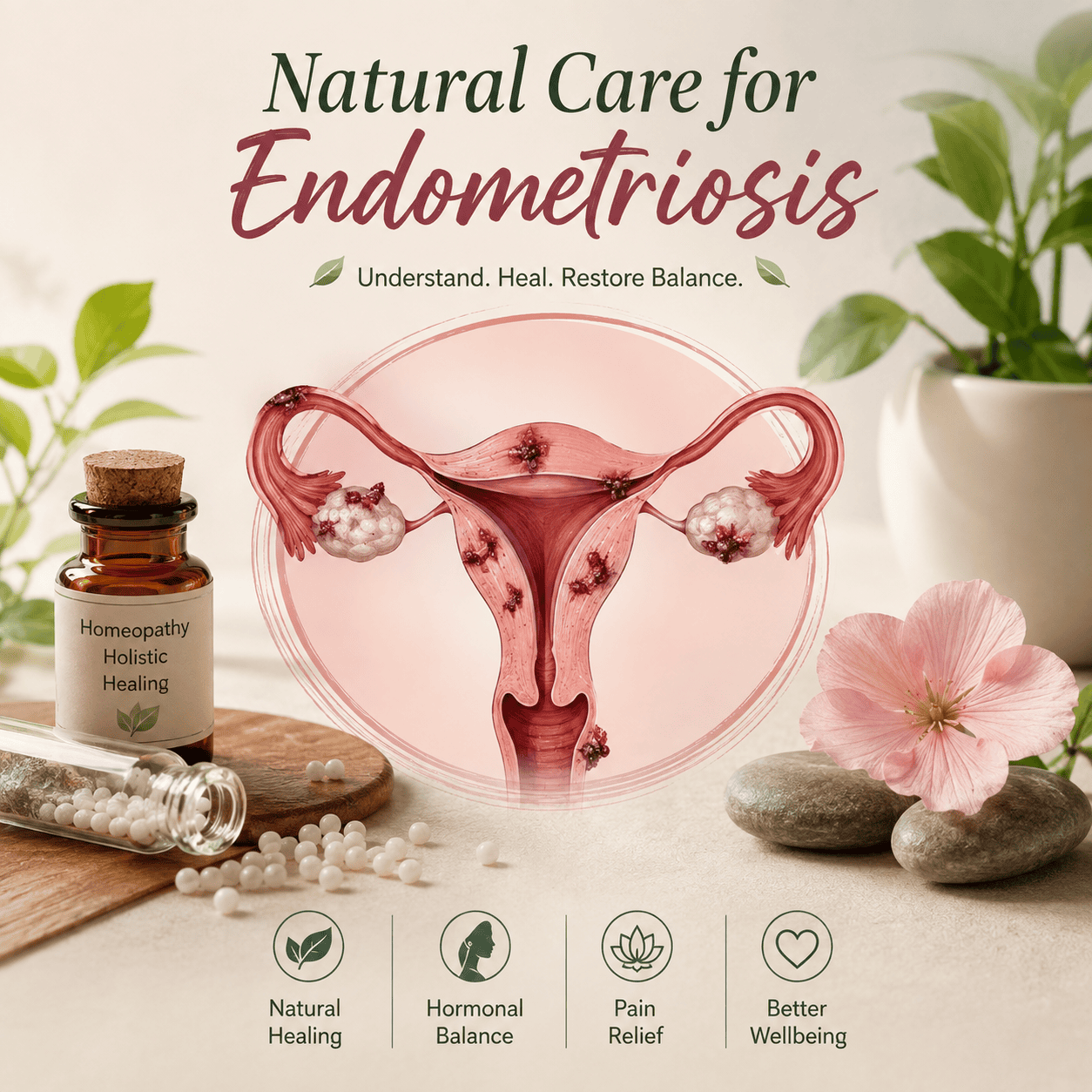
Endometriosis happens when tissue similar to the lining of the uterus starts growing outside it, most often on the ovaries, fallopian tubes, or the lining of the pelvis. Like the normal uterine lining, this misplaced tissue still responds to your monthly hormone cycle. It thickens, breaks down, and bleeds each month, but unlike a normal period, this blood has no way to leave the body.
Over time, this trapped blood and tissue can form what is commonly called a chocolate cyst, or endometrioma, on the ovaries, so named because of the thick, dark, blood-like fluid it contains. It can also lead to inflammation, scar tissue, and adhesions that cause organs in the pelvis to stick together.
Endometriosis vs Adenomyosis vs Endometrial Polyps
These three terms are often confused with each other, so it helps to understand the difference:
- Endometriosis is when uterine-like tissue grows outside the uterus, usually on the ovaries, fallopian tubes, or pelvic lining.
- Adenomyosis is similar in concept but different in location, the uterine lining grows into the muscular wall of the uterus itself, rather than outside it. It often causes heavy, painful periods and an enlarged uterus.
- Endometrial polyps are a separate condition entirely, small, usually benign growths that develop directly inside the uterine cavity from the lining itself. They are more often linked to irregular bleeding than to severe pain.
A woman can have more than one of these conditions at the same time, which is part of why proper diagnosis matters so much.
Common Causes of Endometriosis
The exact cause of endometriosis is still not fully understood, but several factors are believed to contribute:
- Retrograde menstruation The leading theory, where some menstrual blood flows backward through the fallopian tubes into the pelvis instead of leaving the body, allowing endometrial cells to implant there.
- Hormonal imbalance Endometriosis is an estrogen-dependent condition, meaning excess estrogen can fuel the growth of this misplaced tissue. This overlaps with the hormonal picture we discuss in our guide on PCOS homeopathic treatment.
- Immune system factors A poorly functioning immune response may fail to clear misplaced endometrial cells the way it normally would.
- Genetics Having a close relative with endometriosis increases your own likelihood of developing it.
- Surgical scarring Previous pelvic surgery can occasionally allow endometrial cells to attach to a surgical incision.
In most cases, more than one factor is involved, which is why treatment works best when it addresses the whole picture rather than a single cause.
Symptoms to Watch For
Symptoms vary widely between women, and some have very few symptoms at all despite significant disease. Common signs include:
- Severe period pain that is often worse than typical cramping, and may start before bleeding begins. You can read more in our guide on homeopathic treatment for period pain.
- Chronic pelvic pain that is not limited to your period
- Pain during or after intercourse
- Heavy menstrual bleeding, or bleeding between periods
- Digestive symptoms during periods, such as bloating, diarrhea, or constipation
- Fatigue, particularly around and during menstruation
- Difficulty conceiving, since endometriosis is found in a significant number of women investigating female infertility
If your period pain has never felt “normal” compared to what others describe, it is worth taking that seriously rather than assuming it is just something to endure.
Natural and Homeopathic Medicine for Endometriosis in Pakistan
Homeopathy is widely trusted in Pakistan for women’s health concerns, particularly for conditions like endometriosis where conventional options are often limited to hormone therapy or surgery, both of which come with their own trade-offs and do not guarantee the condition will not return.
It is worth understanding one thing clearly. Endometriosis affects every woman differently, in location, severity, and the symptoms it produces. In true homeopathic care, the remedy is always chosen for the individual case, not the diagnosis alone. Two women with confirmed endometriosis may need entirely different remedies, based on the nature of their pain, their emotional state, and their overall constitution.
This is why a personalized consultation with a qualified homeopath gives far better and longer-lasting results than a generic protocol.
Best Homeopathic Remedies for Endometriosis
In homeopathy, the remedy is matched to the person and the specific character of their pain and symptoms. A doctor chooses it based on the nature of the pain, the bleeding pattern, and the woman’s overall health. Some of the commonly used remedies are below. The exact remedy and its strength should always be decided by a homeopathic doctor, never on your own.
- Sepia
Often considered a central remedy for endometriosis, particularly with a bearing-down sensation.Indicated in:- Dragging, bearing-down pain in the pelvis
- Irregular or heavy periods
- Exhaustion and indifference
- Reduced interest in intimacy due to pain
- Lachesis
Suited to left-sided pelvic pain that intensifies before the period begins.Indicated in:- Pain worse on the left side
- Symptoms that improve once bleeding starts
- Marked premenstrual irritability
- A sensation of congestion or fullness in the pelvis
- Pulsatilla
Considered where the emotional pattern is gentle and changeable, alongside period irregularities.Indicated in:- Changeable, shifting pain
- Irregular or delayed periods
- Weepy, emotional mood
- Symptoms that ease with comfort and gentle movement
- Nux Vomica
Useful where pain comes with strong pelvic pressure and digestive disturbance.Indicated in:- Irregular, painful periods with a constant urge for a bowel movement
- Heavy flow with a bearing-down sensation
- Nausea, especially in the morning
- Irritability, often linked to a high-stress lifestyle
- Colocynth
Indicated for severe, cramping pelvic pain that eases with pressure.Indicated in:- Griping, severe cramping pain
- Relief from bending double or firm pressure
- Pain that intensifies with stress or anger
- Thuja Occidentalis
Considered where cystic changes, such as chocolate cysts, are a prominent feature.Indicated in:- History of ovarian cysts
- Oily skin or skin changes alongside the hormonal picture
- A tendency toward growths or cystic changes elsewhere in the body
Important: these remedies are shared for informational purposes only. Homeopathic treatment for endometriosis should always be prescribed and supervised by a qualified homeopath after a full case evaluation. Self-medicating without proper diagnosis is not recommended, since the correct remedy depends on your complete symptom picture, not just a single symptom in isolation.
Frequently Asked Questions
What is the best natural treatment for endometriosis?
There is no single treatment that works the same for every woman. A combination of an anti-inflammatory diet, stress management, and individualized homeopathic remedies chosen for your specific symptom pattern tends to offer the most well-rounded natural support.
What is the difference between endometriosis and adenomyosis?
Endometriosis involves uterine-like tissue growing outside the uterus, most often on the ovaries or pelvic lining. Adenomyosis involves that tissue growing into the muscular wall of the uterus itself. The two can occur together and share some symptoms, but they affect different parts of the body.
Is an endometrial polyp the same as endometriosis?
No. Endometrial polyps are growths that develop inside the uterine cavity, from the uterine lining itself, and are more commonly associated with irregular bleeding than with the chronic pain typical of endometriosis. They are a separate condition, even though the names sound similar.
Can homeopathy help with endometriosis-related infertility?
Many women with endometriosis-related fertility difficulties turn to homeopathy to help support hormonal balance and reduce inflammation. Results vary by individual case, and treatment is often most effective when started as early as possible under proper guidance.
Conclusion
Endometriosis is far more common, and far more often dismissed, than most women realize. If your period pain has never felt ordinary, that instinct deserves to be taken seriously rather than pushed aside for years.
Homeopathy offers a gentle, natural way to support your body through endometriosis by addressing hormonal balance and inflammation at their root, alongside proper medical care. With the right remedy, supportive lifestyle changes, and timely diagnosis, real relief is possible.
Note from the Clinic
At Binte Shifa Homeopathic Clinic, we understand how exhausting it can be to have your pain dismissed for years before finding real answers. Our approach focuses on finding the root cause and restoring your body’s natural balance through gentle, personalized homeopathic care.
If you suspect endometriosis or are already living with it, you do not have to manage it alone. Book a consultation with Dr Asia Nazir for safe, natural, and individual guidance.